
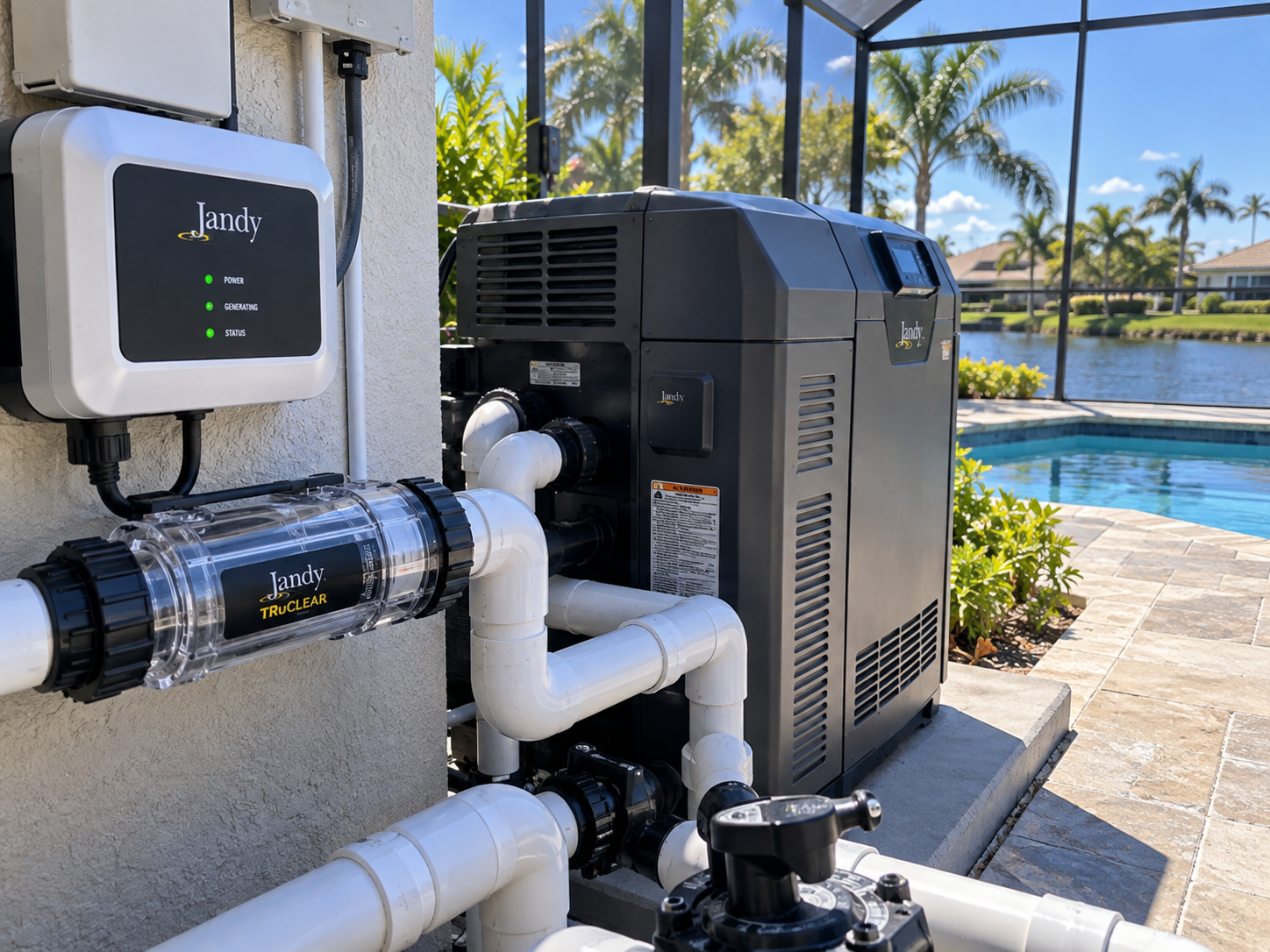
Upgrading your pool equipment is one of the best investments you can make in your backyard, and in Southwest Florida, two pieces of equipment make the biggest difference in how much you enjoy your pool and how much it costs to maintain: the salt cell and the pool heater. Sunseeker Pool and Spa serves Venice, Sarasota, North Port, Port Charlotte, Wellen Park, Englewood, and surrounding communities across Sarasota, Manatee, and Charlotte counties, and our team installs, repairs, and replaces both every week. This guide covers what you need to know before you buy.
Why Southwest Florida Pools Need the Right Equipment
The Gulf Coast climate is one of the best in the country for pool ownership. The season is essentially year-round, which means your equipment runs more hours annually than pools in seasonal climates. That constant demand accelerates wear and makes the quality and efficiency of your equipment more consequential here than in markets where the pool goes dormant for five months.
Salt air is the other factor that sets Southwest Florida pools apart. The proximity to the Gulf and the Intracoastal accelerates corrosion on metal components, electrode plates, and equipment connections. Choosing equipment rated for coastal environments and installing it correctly makes a measurable difference in how long it lasts.
Hard water is also a real consideration across Sarasota, Charlotte, and Manatee counties. High mineral content in the water causes scale to build up on salt cell electrode plates, inside heater heat exchangers, and throughout plumbing fittings. Proper water chemistry management extends the life of both pieces of equipment significantly.
Salt Cell Buying Guide
What a Salt Cell Does
A salt chlorine generator, commonly called a salt system, converts dissolved salt in the pool water into chlorine through an electrolytic process. The salt cell is the component that does the conversion: pool water passes over electrically charged electrode plates coated with ruthenium or titanium, and the electrical current breaks sodium chloride molecules apart into chlorine gas that immediately dissolves into the water as hypochlorous acid.
The result is a pool that sanitizes itself continuously rather than relying on manually added chlorine. Saltwater pools are not chlorine-free. They are self-chlorinating, which is an important distinction. The chlorine level in a well-maintained saltwater pool is actually lower and more stable than in a traditionally chlorinated pool, which is why swimmers report softer water and less irritation to eyes and skin.
What to Look for When Buying a Salt Cell
Cell size and pool volume match. Salt cells are rated by the pool volume they are designed to handle. A cell that is undersized for your pool will run at maximum output constantly and burn out prematurely. A cell properly sized for your pool runs at moderate output, lasts longer, and handles the chlorine demand of Southwest Florida's year-round swim season. Sunseeker sizes every salt system installation to the specific pool's volume and usage pattern.
Electrode plate quality. The electrode plates are the heart of the salt cell, and the quality of the coating determines how long the cell lasts. Better cells use thicker ruthenium or titanium coatings that resist the scale buildup and wear that is particularly aggressive in Florida's hard water. Budget cells with thin coatings may need replacement in two to three years. Quality cells from manufacturers like Jandy last five to seven years or longer with proper maintenance.
Automatic cleaning. Higher-quality salt cells include a self-cleaning or reverse polarity feature that periodically reverses the electrical charge on the plates, causing scale to flake off rather than accumulate. In Southwest Florida's hard water, this feature is not a luxury. It is the difference between cleaning your cell manually every month and cleaning it once or twice a year.
Compatible automation. If your pool has or will have an automation system, verify that the salt cell is compatible with it. A cell that integrates with your automation controller lets you monitor chlorine output, salt levels, and cell health from a single interface rather than checking a separate display at the equipment pad.
Warranty. Salt cell warranties typically range from one year on budget units to three to five years on premium models. Given the replacement cost of a cell, a strong warranty is meaningful.
When to Replace Your Salt Cell
Most salt cells last between four and seven years depending on water chemistry management, cell size relative to pool volume, and the quality of the original unit. Signs that a cell is nearing the end of its life include consistently low chlorine output despite correct salt levels, visible pitting or deterioration on the electrode plates, and error codes on the controller indicating plate failure.
A common mistake is repeatedly cleaning a cell that has reached the end of its plate life. Acid washing removes scale but cannot restore a plate that has lost its coating. At that point, the cell needs replacement rather than maintenance.
What Salt Level Does a Southwest Florida Pool Need?
Most salt chlorine generators are designed to operate with a salt concentration between 2,700 and 3,500 parts per million. This is well below the threshold where humans can taste salt in water, which is approximately 3,500 to 4,000 ppm. Many Southwest Florida pool owners describe their saltwater pool as feeling slightly silkier than a traditionally chlorinated pool, not noticeably salty.
Maintaining the correct salt level matters for cell performance and longevity. Too little salt causes the cell to work harder. Too much salt can cause corrosion on metal components and is wasteful. A simple salt test at each service visit keeps the level in range.
Pool Heater Buying Guide
Do You Need a Pool Heater in Southwest Florida?
The honest answer is that it depends on your goals and your schedule. If you swim primarily from April through October and do not mind cooler water from December through February, you can get by without one. Gulf water temperatures and ambient air in Southwest Florida do moderate Florida pool water even without a heater, and many homeowners swim comfortably for nine or ten months a year without one.
If you want to swim year-round, including the occasional cold snap that brings Venice and Port Charlotte temperatures into the 40s and 50s overnight, a heater is the tool that keeps the pool usable. For vacation rental properties and homes where the pool needs to be ready for guests at any time of year, a heater is essentially required.
Gas Heaters
Gas heaters heat water by burning natural gas or propane through a heat exchanger. They are the fastest heating method available, capable of raising water temperature by one to two degrees per hour in a typical Southwest Florida pool. That speed makes them ideal when you need the pool warm in a hurry, for incoming guests, an impromptu family gathering, or a cold evening that dropped the temperature overnight.
The tradeoff is operating cost. Gas heaters are not particularly efficient, and in a year-round swimming market like Southwest Florida where a heater might see regular use from November through March, the monthly fuel cost is noticeable. Natural gas is less expensive than propane per BTU, but many Southwest Florida properties in Charlotte County and rural Sarasota County are not on a natural gas line, which means propane is the fuel source.
Gas heaters work regardless of ambient air temperature, which is their primary advantage over heat pumps. On a cold January night when air temperatures drop below 50 degrees, a gas heater keeps heating. A heat pump in the same conditions may struggle.
Jandy is Sunseeker's preferred heater brand. Jandy heaters are built for coastal Florida conditions, carry strong warranties, and integrate cleanly with Jandy automation systems for easy control.
Heat Pump Heaters
Heat pump heaters extract heat from the ambient air and transfer it to the pool water using a refrigeration cycle. They are significantly more efficient than gas heaters on a per-BTU basis. A heat pump that costs 20 cents of electricity to produce a BTU of heat would cost a gas heater roughly 70 cents or more to produce the same output. Over a full heating season, that efficiency difference adds up substantially.
Heat pumps are the right choice for homeowners who want consistent year-round pool temperatures without the higher operating cost of gas. They heat more slowly than gas heaters but maintain temperature well once the pool is at the target setpoint.
The limitation in Southwest Florida is that heat pump efficiency drops as ambient air temperature falls. Most residential heat pumps operate effectively down to about 45 to 50 degrees Fahrenheit. On the coldest winter nights in Venice and Port Charlotte, which occasionally drop into the 30s, a heat pump may not be able to maintain temperature on its own. For most of the Southwest Florida winter, though, ambient temperatures stay well above that threshold and heat pumps perform well.
Many Southwest Florida pool owners choose a heat pump as the primary heater for its efficiency and pair it with a gas heater for backup during cold snaps. This combination gives you year-round heating capability at the lowest average operating cost.
Solar Heaters
Solar heating systems use roof or rack-mounted panels to capture heat from the sun and circulate pool water through them. Southwest Florida's abundant sunshine makes solar a legitimate option for extending the swim season, particularly in the spring and fall shoulder periods when ambient temperatures are warm but pool water lags behind.
Solar is the lowest-cost option from an operating standpoint because sunlight is free. The tradeoff is that solar systems heat slowly and depend entirely on sun exposure. On cloudy winter days or during cold nights, a solar system provides no useful heating output. For year-round use, solar works best as a supplement rather than a standalone solution.
Sizing Your Pool Heater
Heater sizing depends on pool surface area, desired temperature rise, and how quickly you need to heat the pool. An undersized heater runs constantly without reaching temperature. An oversized heater costs more upfront than necessary. Sunseeker sizes every heater installation to the specific pool and usage pattern and provides a clear recommendation before any purchase is made.
What Installation Involves
Both salt cell and heater installations are equipment pad projects. The existing plumbing configuration determines how involved the installation is.
A salt cell installation connects the cell housing into the return line after the filter and heater, with the control unit mounted near the equipment pad and wired to the pool's electrical system. The process is typically completed in a few hours.
A heater installation connects the unit into the plumbing at the equipment pad, typically after the filter and before the return line, and establishes the fuel supply connection. For a gas heater replacing an existing unit at an established connection, installation is usually a single-day job. For a new gas heater where a gas line needs to be run or a propane system needs to be configured, the scope increases accordingly.
Both installations require proper permitting in Florida, and Sunseeker handles the permitting process as part of the project.
The Current Sunseeker Promotion
Sunseeker is currently offering $250 off a new pool heater and $250 off a new salt cell for qualifying projects. The offer cannot be combined and is limited to one coupon per household on new projects. If you have been considering either upgrade, this is a good time to get it scheduled before the promotions change.
FAQ
How long does a salt cell last in a Southwest Florida pool?
Most quality salt cells last between four and seven years in Southwest Florida pools with proper water chemistry maintenance. Hard water accelerates scale buildup on the electrode plates, which is why regular cleaning and water balance are more important here than in softer water markets. A cell that is correctly sized for the pool and maintained properly will reach the higher end of that range.
Is a heat pump or a gas heater better for a Venice or Port Charlotte pool?
For most Southwest Florida homeowners, a heat pump is the more cost-effective choice for year-round use because of its significantly lower operating cost. A gas heater heats faster and performs better during the rare hard freeze. Many homeowners choose a heat pump as the primary unit and install a gas heater for backup during cold snaps. Sunseeker can help you evaluate which setup makes sense for your specific usage pattern.
Can Sunseeker install a salt system on an existing pool that currently uses traditional chlorine?
Yes. Converting an existing chlorine pool to a salt system is a straightforward upgrade. The installation involves adding the salt cell housing to the return line and mounting the controller at the equipment pad. The pool's existing plumbing and filtration system stay in place. You add salt to reach the operating concentration and the system takes over from there.
How does Southwest Florida's salt air affect pool equipment?
Salt air accelerates corrosion on metal components including equipment housings, electrical connections, and heat exchanger components. Choosing equipment from manufacturers that design for coastal environments, installing it correctly with weather-resistant hardware, and keeping the equipment pad clean and dry extends the life of both heaters and salt systems significantly. Jandy equipment, which Sunseeker installs and services, is designed with coastal Florida conditions in mind.
How soon can Sunseeker schedule a salt cell or heater installation in the Venice area?
Contact us at (941) 299-7665 or reach out through the website to check current availability. Equipment installations are typically scheduled within one to two weeks. If you want to take advantage of the current $250 off promotion, reach out sooner rather than later to lock in your appointment.
Ready to Upgrade? Sunseeker Can Help.
Sunseeker Pool and Spa installs, repairs, and replaces salt cells and pool heaters for residential pools across Venice, Sarasota, North Port, Wellen Park, Port Charlotte, Englewood, and surrounding Southwest Florida communities. CPC licensed, locally owned, and backed by a 5.0 Google rating. Call (941) 299-7665 or contact us online to get started.